
Confused about IELTS?
Whether you are planning to study abroad, explore international career opportunities, or migrate to an English-speaking country, understanding IELTS is the first step towards planning your journey. IELTS is one of the most widely recognised English-language proficiency tests. But before you book your test or begin practising hundreds of questions, it is important to understand how the exam works, which version you need, how your score is calculated, and how to prepare effectively. In this guide, Athovia explains everything a beginner needs to know about IELTS—and how to begin preparation with a clear plan rather than guesswork.
What Is IELTS?
IELTS stands for International English Language Testing System. It assesses how effectively you can use English in listening, reading, writing, and speaking situations.
The test is designed to measure your English proficiency for purposes such as higher education, professional registration, employment, and migration, depending on the requirements of the organisation or authority you are applying to.
IELTS assesses four skills:
Listening: Understanding spoken English, including conversations and monologues.
Reading: Understanding written texts, identifying information, and interpreting ideas.
Writing: Communicating ideas clearly, logically, and accurately in writing.
Speaking: Expressing ideas verbally with appropriate fluency, vocabulary, grammar, and pronunciation.
Your performance is reported using a band score ranging from 0 to 9.
Remember: IELTS is not simply a test of how many English words you know. It assesses how effectively you can understand and communicate in English.
Why Do People Take IELTS?
People take IELTS for different reasons, and the score they need depends on their individual goals.
1. Higher education
Universities and educational institutions may require IELTS scores as evidence of English proficiency for admission to undergraduate or postgraduate programmes.
2. Migration
Some immigration authorities accept IELTS as evidence of English proficiency. The accepted test type and required score depend on the country, visa category, and current regulations.
3. Professional registration
Certain professional bodies may require proof of English proficiency before granting registration or eligibility to practise.
4. Career opportunities
Some employers use English proficiency requirements when recruiting candidates for roles involving international communication.
Before booking your test: Always check the exact test type and score requirements published by your target university, employer, professional body, or immigration authority.
What Are the Different Types of IELTS?
The two main versions most candidates consider are IELTS Academic and IELTS General Training.
IELTS Academic
IELTS Academic is generally intended for people applying for higher education or certain professional registration pathways where this test is accepted.
Its Reading and Writing sections assess skills relevant to academic or formal contexts.
IELTS General Training
IELTS General Training is generally intended for people who need to demonstrate English proficiency for certain migration, work, training, or other non-academic purposes.
Its Reading and Writing sections use different tasks and materials from IELTS Academic.
IELTS Academic vs General Training
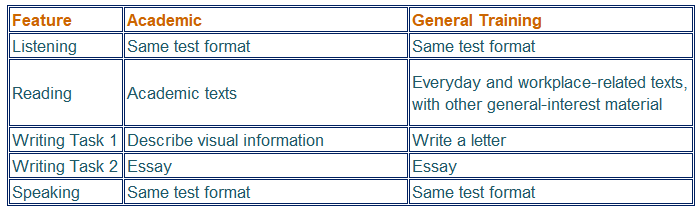
The Listening and Speaking formats are the same for both versions, while Reading and Writing differ.
Which one should you choose? Do not decide based on which test seems easier. Confirm the test type required for your specific purpose.
What Is the IELTS Test Format?
IELTS has four sections. Each assesses a different aspect of English proficiency.
Open link: Understand Test Format IELTS in under 60 secs
1. IELTS Listening
Duration: Approximately 30 minutes, with additional transfer time for paper-based Listening where applicable.
You listen to recordings and answer questions based on the information you hear.
Common question types include:
Multiple choice
Form and note completion
Matching
Map or diagram labelling
Sentence completion
What makes Listening challenging?
You may hear the correct information but miss the answer because you were distracted, misunderstood a paraphrase, or failed to notice that the speaker changed their initial answer.
Preparation tip: Practise predicting the type of answer required before listening, then review why you missed each incorrect response.
2. IELTS Reading
Duration: 60 minutes.
You read passages and answer questions that assess comprehension, information retrieval, inference, and recognition of the writer's ideas.
Common question types include:
True / False / Not Given
Yes / No / Not Given
Matching headings
Multiple choice
Sentence completion
Summary completion
Academic and General Training Reading differ in their texts and structure.
What makes Reading challenging?
Many candidates spend too much time reading every sentence in detail or choose answers based on familiar words rather than the meaning of the passage.
Preparation tip: Learn to identify keywords, recognise synonyms, and distinguish what the text states from what it does not establish.
3. IELTS Writing
Duration: 60 minutes.
Writing contains two tasks, with Task 2 carrying more weight than Task 1 in the Writing score.
For IELTS Academic:
Task 1: Describe and summarise visual information, such as a graph, chart, table, map, or process.
Task 2: Write an essay responding to a question or issue.
For IELTS General Training:
Task 1: Write a letter for a given situation.
Task 2: Write an essay responding to a question or issue.
What makes Writing challenging?
Students may focus on difficult vocabulary and long sentences without developing their ideas clearly or organising their arguments effectively.
Preparation tip: Focus on answering the question, developing relevant ideas, organising paragraphs logically, and using vocabulary and grammar accurately.
4. IELTS Speaking
Duration: Approximately 11–14 minutes.
The Speaking test is a face-to-face interview with an examiner, conducted in person or by video call where available.
It has three parts:
Part 1: Questions about familiar topics, such as work, studies, hobbies, or daily life.
Part 2: An individual long turn based on a cue card, with preparation time.
Part 3: A discussion involving more abstract ideas related to the Part 2 topic.
What makes Speaking challenging?
Candidates may hesitate, repeat the same words, give underdeveloped answers, or rely on memorised responses.
Preparation tip: Practise expressing one clear idea, explaining your reason, and supporting it with a relevant example.
How Is IELTS Scored?
IELTS uses a band scale from 0 to 9.
You receive individual scores for Listening, Reading, Writing, and Speaking, as well as an overall band score.
These descriptions provide a broad interpretation of proficiency; the official band descriptors provide more detail about performance at each level.
Your overall score is calculated from the four component scores and rounded according to IELTS scoring rules.
Is Band 7 a good IELTS score?
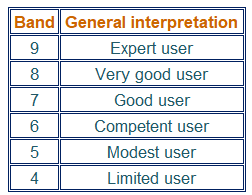
Band 7 is described as a Good User level. It indicates operational command of English, although occasional inaccuracies, inappropriate usage, or misunderstandings may still occur.
Whether Band 7 is sufficient depends on your goal. A university, employer, professional body, or immigration authority may specify a particular overall score and minimum scores in individual skills.
The important point: Do not prepare for an assumed target. Identify the score you actually need before designing your study plan.
How Long Does It Take to Prepare for IELTS?
There is no single preparation timeline that works for every candidate.
Your preparation time depends on:
Your current English proficiency
Your target band score
Your strongest and weakest skills
The amount of time you can study consistently
The quality of feedback and practice you receive
A candidate already performing close to their target may need a different plan from someone who needs to strengthen foundational reading, grammar, or speaking skills.
How should you begin?
Step 1: Understand your target. Confirm the score and test type required for your goal.
Step 2: Establish your baseline. Attempt appropriate diagnostic tasks to understand your current performance.
Step 3: Identify your gaps. Separate problems involving language knowledge from problems involving question types, timing, accuracy, or task response.
Step 4: Practise with purpose. Work on the specific skills that need improvement rather than completing practice tests without reviewing mistakes.
Step 5: Review and adjust. Track recurring errors and change your preparation strategy as your performance develops.
This is the difference between simply spending time on IELTS and preparing with a clear improvement plan.
Common IELTS Preparation Mistakes Beginners Should Avoid
1. Taking mock tests without analysing mistakes
A practice test shows how you performed on a particular attempt. Reviewing errors helps you understand what needs to change.
2. Memorising vocabulary without learning its usage
Knowing a word's definition does not guarantee that you can use it accurately in Speaking or Writing. Learn vocabulary in context, including collocations and natural sentence patterns.
3. Memorising complete essays or speaking answers
Prepared structures can help you organise your ideas, but relying on memorised responses can make your answers irrelevant or unnatural. Practise adapting your language to the actual question.
4. Ignoring one skill
A strong result in one section does not automatically compensate for every requirement in another. If your target includes minimum scores for individual skills, plan for those requirements separately.
5. Following the same plan as everyone else
Two learners aiming for the same band may have very different needs. One may struggle with Reading accuracy, while another needs to develop Writing arguments or Speaking fluency.
Your preparation should reflect your current performance, not simply someone else's routine.
How Can Athovia Help You Prepare Smarter for IELTS?
At Athovia, we believe effective preparation begins with understanding what you need to improve.
OnMissionIELTS by Athovia brings together structured IELTS preparation, human mentoring, and AI-powered evaluation to support a more focused learning experience.
The approach centres on three principles:
1. Understand your current level. Establish a clearer picture of your strengths and improvement areas.
2. Practise with purpose. Focus on specific skills and recurring errors instead of relying only on repetitive practice.
3. Learn with guidance and feedback. Combine human mentoring with AI-powered evaluation to support informed practice and improvement.
Technology can help analyse performance and deliver feedback, while a human mentor can provide context, guidance, and support with your learning strategy.
The goal is not simply to do more IELTS questions. It is to make your preparation more deliberate and productive.
Ready to Begin Your IELTS Journey?
You do not need to have everything figured out before you start. You need to understand the test, know your target, and take the right first step.
Start by discovering where you stand.
Take Athovia's FREE IELTS ASSESSMENT to begin understanding your current level and the areas you may need to work on.
Explore OnMissionIELTS by Athovia for structured preparation supported by human mentoring and AI-powered evaluation.
Learn smarter. Achieve more.
Visit: https://athovia.com/