

Thousands of IELTS aspirants prepare diligently, memorize extensive lists of transition words, and write daily practice essays, only to receive their test results and see the same frustrating number: Band 6.0 or Band 6.5.
The "Band 6.5 Plateau" is the single most common roadblock in IELTS Academic and General Training. For immigration pathways (like Canada Express Entry) or top university admissions, a Band 7.0 or higher in each module is often non-negotiable.
Scoring Band 7+ is not about memorizing ornate 19th-century vocabulary or packing an essay full of complex clauses. Examiners grade against an objective, four-part rubric.
Below is the exact blueprint to align your writing with the Band 7+ standard.
1. Deconstructing the 4 Official Band Descriptors
IELTS Writing Task 2 is assessed using four criteria, each carrying 25% of your score:
Task Response (TR)
Coherence and Cohesion (CC)
Lexical Resource (LR)
Grammatical Range and Accuracy (GRA)
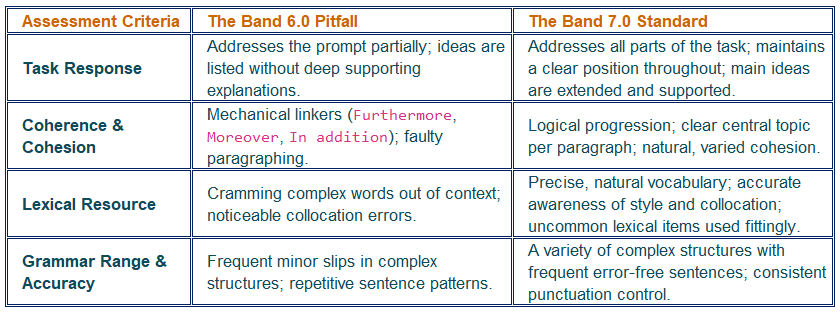
2. The Fallacy of "Sounding Smart" (Lexical Resource)
A common mistake among candidates is replacing simple, clear English with archaic synonyms.
Candidate Draft (Band 6.0):
"It is an indisputable truth that the ubiquitous proliferation of motorized automobiles leads to cataclysmic detriment to the pristine atmosphere."
(Problem: Stilted, dramatic, and unnatural tone.)
Band 7.5+ Revision:
"It is evident that the widespread reliance on private vehicles significantly degrades urban air quality."
(Why it works: Precise vocabulary—
widespread reliance,private vehicles,significantly degrades—used with natural academic collocation.)
Examiners evaluate your ability to use topic-specific vocabulary accurately rather than forcing thesaurus replacements.
3. The 4-Paragraph Essay Structure for Band 7+
Achieving a Band 7+ requires an essay structure that emphasizes depth over breadth. Two well-developed ideas score significantly higher than four superficial ones.
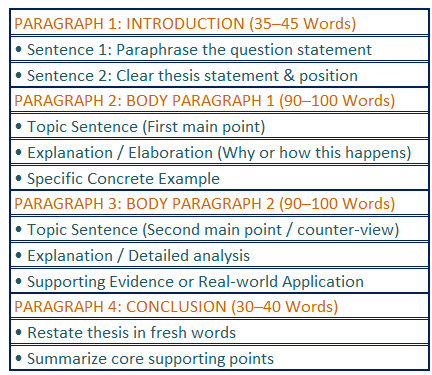
The PEEL Framework for Body Paragraphs
To guarantee full Task Response points, structure each body paragraph around PEEL:
P — Point: Clearly state your argument in the first sentence.
E — Explanation: Detail why this point is valid and how the mechanism works.
E — Example: Provide an illustrative scenario, policy, or real-world trend.
L — Link: Tie the idea back to the core essay prompt.
4. Side-by-Side Analysis: Band 6.0 vs. Band 7.5
Some people believe that unpaid community service should be a compulsory part of high school programmes. To what extent do you agree or disagree?
Band 6.0 Body Paragraph
Firstly, doing community service makes students learn good values. For example, they can help old people or clean parks. Furthermore, if they do not do this, they will only play computer games and waste their time. Thus, it is very advantageous for schools to make it mandatory for everybody.
Examiner Feedback: The ideas are generic. The transition from volunteering to "playing computer games" is an unsupported generalization. Linkers (
Firstly,Furthermore,Thus) feel mechanical.
Band 7.5+ Body Paragraph
Incorporating mandatory volunteer work into secondary education cultivates civic responsibility from an early age. When adolescents participate in local initiatives—such as assisting at food banks or organizing environmental clean-up drives—they gain direct exposure to socioeconomic challenges beyond their immediate environment. This practical engagement helps develop empathy and teamwork skills that traditional classroom settings often fail to foster. Consequently, community service enriches a student’s character while directly benefiting local communities.
Examiner Feedback: The argument progresses logically. Academic phrases like
cultivates civic responsibility,socioeconomic challenges, andpractical engagementdemonstrate natural collocation without feeling forced.
5. How to Accelerate Your Writing Preparation
Fixing deep-rooted grammatical habits and tone inconsistencies through self-study alone can be challenging because writers rarely spot their own blind spots.
Progress in IELTS Writing generally follows a structured feedback cycle:
Identify Recurring Errors: Categorize your mistakes (e.g., article misuse, subject-verb agreement, or weak topic sentences).
Combine Diagnostic Tools with Mentor Review: Automated diagnostic tools spot grammatical patterns instantly, while experienced human educators assess nuanced aspects like essay tone, argument logic, and task achievement.
Rewrite and Iterate: Rather than writing ten distinct essays poorly, write one, receive detailed feedback, and rewrite it until it meets Band 7.5 standards.
Frequently Asked Questions (FAQ)
Why do many test-takers get stuck at Band 6.5 in IELTS Writing?
Most candidates get stuck at Band 6.5 due to overusing memorized templates, forcing obscure vocabulary in unnatural contexts, and failing to fully develop their main arguments.
How many words should I write for IELTS Writing Task 2?
The minimum requirement is 250 words. Aim for 265 to 285 words—this gives sufficient scope for fully developed arguments while preserving time for planning and proofreading.
Does complex vocabulary guarantee a Band 7 or higher?
No. Examiners prioritize natural collocation, precision, and context over unusual words. An incorrect word choice can lower your Lexical Resource score.
Master IELTS Writing with Athovia
Looking to move from Band 6.5 to Band 7.5+? Discover the
Book your
Free Assessment Join our next
Live Masterclass