
Choosing the wrong IELTS test can cost you time, money, and preparation effort.
Before you book your exam, understand the difference between IELTS Academic and IELTS General Training, and choose the version that matches your study, career, or immigration goals. Both tests assess your English proficiency through Listening, Reading, Writing, and Speaking. However, the purpose of each test—and the Reading and Writing tasks—differs. The right choice depends primarily on what your university, employer, professional body, or immigration authority requires. In this guide, we’ll compare both IELTS test types so you can make an informed decision.
1. What Is IELTS Academic?
IELTS Academic is designed primarily for people who plan to pursue higher education or need to demonstrate English proficiency for certain professional registration requirements.
You may need IELTS Academic if you are:
Applying for an undergraduate or postgraduate degree at a university.
Planning to study in an English-speaking country.
Applying for professional registration in a field that requires proof of English proficiency.
Meeting a specific institution’s English-language entry requirements.
The test assesses whether you can understand and use English in an academic environment, including interpreting information, understanding complex texts, and presenting ideas clearly.
Example: If you are applying for a master's degree at a university overseas, IELTS Academic may be the appropriate test—but always check the university’s specific requirements.
2. What Is IELTS General Training?
IELTS General Training focuses more on practical English used in everyday life, social situations, and workplace environments.
It may be suitable if you are:
Applying for immigration to an English-speaking country.
Seeking employment or work-related opportunities where IELTS General Training is accepted.
Planning to undertake training or study below degree level.
Meeting a specific visa or institutional English-language requirement.
The test assesses your ability to understand everyday information, communicate in common situations, and use English in practical contexts.
Example: If you are planning to migrate to Canada, Australia, New Zealand, or the UK, General Training may be relevant. However, immigration rules vary by country, visa category, and application route, so confirm the exact test accepted for your application before booking.
3. IELTS Academic vs General Training: Key Differences
Here is a quick comparison of the two tests.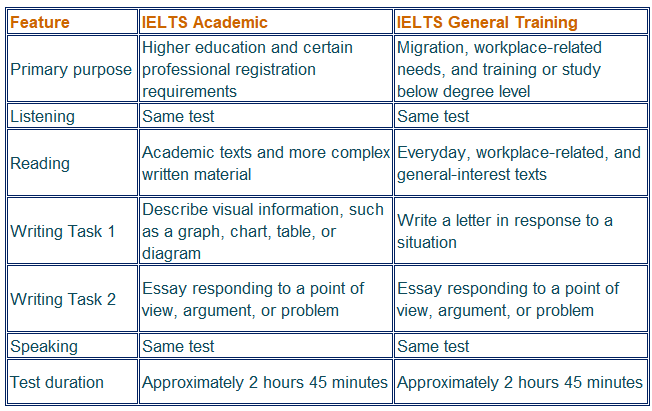
The key difference is in Reading and Writing. Listening and Speaking are the same in both versions.
4. What Is the Difference Between Academic and General Training Reading?
Both Reading tests assess your ability to understand written English, locate information, identify ideas, and interpret meaning. The types of texts, however, are different.
IELTS Academic Reading
Academic Reading uses texts that may come from books, journals, magazines, newspapers, or other sources. These texts can include descriptive, factual, analytical, and discursive material.
You may need to:
Identify the main idea of a passage.
Locate specific information.
Understand an author's opinion or argument.
Recognise relationships between ideas.
Interpret vocabulary in context.
Distinguish facts from claims or opinions.
IELTS General Training Reading
General Training Reading uses material closer to what you might encounter in everyday life and at work.
Examples include:
Notices and advertisements.
Instructions and public information.
Workplace documents and job descriptions.
Company policies or training information.
Longer passages on general-interest topics.
Which Reading test is easier?
There is no universal answer. General Training texts may be more familiar because they often reflect everyday situations, while Academic Reading can involve more complex academic material.
However, familiar topics do not automatically mean an easier score. Your result depends on how accurately you understand the text, interpret the questions, and locate the correct answers.
The best preparation strategy is to practise the exact test version you intend to take.
5. What Is the Difference Between Academic and General Training Writing?
Writing Task 1 is one of the biggest differences between the two IELTS versions.
IELTS Academic Writing Task 1
You are given visual information, such as a chart, graph, table, map, or process diagram, and must describe or summarise it in your own words.
You need to identify the most important features, make relevant comparisons, and organise information logically.
For example, you might be asked to summarise changes in public transport usage over a period of ten years.
Your response should focus on the information presented rather than personal opinions.
IELTS General Training Writing Task 1
You are given a situation and asked to write a letter. Depending on the task, the letter may be formal, semi-formal, or personal.
You might need to:
Request information.
Explain a problem.
Make a complaint.
Invite someone to an event.
Thank someone or provide an explanation.
Your response should address all the points in the question and use a tone appropriate to the recipient.
What about Writing Task 2?
Writing Task 2 is broadly similar in both versions. You write an essay in response to a point of view, argument, or problem.
You should aim to:
Answer every part of the question.
Present a clear position where required.
Develop ideas with relevant explanations and examples.
Organise paragraphs logically.
Use accurate and appropriate vocabulary and grammar.
Task 2 contributes twice as much as Task 1 to your Writing score, so it deserves particular attention during preparation.
6. Are Listening and Speaking Different?
No. The Listening and Speaking tests are the same for IELTS Academic and IELTS General Training.
IELTS Listening
You listen to recordings featuring different situations and answer questions based on the information you hear.
The test includes conversations and monologues involving everyday, social, educational, or training-related contexts.
Your preparation should focus on understanding different accents, identifying keywords, following the development of information, and checking spelling and word limits.
IELTS Speaking
The Speaking test is an interview with an examiner and has three parts:
Part 1 — Introduction and interview: Questions about familiar topics, such as work, studies, home, and interests.
Part 2 — Long turn: You receive a topic card, have one minute to prepare, and speak for up to two minutes.
Part 3 — Discussion: You discuss broader and more abstract issues related to the Part 2 topic.
You do not need to memorise different answers for Academic and General Training. Instead, develop the ability to communicate clearly, organise your thoughts, and respond naturally.
7. Which IELTS Test Should You Take?
Use this decision guide as a starting point.
Choose IELTS Academic if:
You are applying for higher education.
Your professional registration body requires Academic IELTS.
Your university or institution specifically asks for Academic IELTS.
Consider IELTS General Training if:
You are applying through an immigration route that accepts it.
Your purpose involves workplace-related English or training below degree level.
Your relevant authority or institution specifically requires General Training.
Still unsure? Do not choose based only on which version sounds easier. Check the official requirements for your exact destination, visa category, university, employer, or professional body.
A test that is accepted for one application may not be accepted for another, even within the same country.
8. Is IELTS Academic Harder Than General Training?
Many candidates assume that Academic IELTS is always harder because the Reading passages can be more technical and the Writing Task 1 requires interpreting visual information.
However, difficulty is personal. Academic Reading may challenge candidates who struggle with complex texts, while General Training Reading still requires careful reading and accurate answers. Writing Task 1 also demands different skills in each version.
The more useful question is not, “Which test is easier?” but:
“Which test do I need, and what skills must I improve to achieve my target band?”
Once you know your test type, you can focus on the correct question formats, timing strategies, vocabulary, and writing requirements.
9. How Should You Prepare for Your IELTS Test?
Regardless of which version you take, effective preparation begins with understanding your current performance.
Follow these steps:
Step 1: Confirm your test type
Check the requirements of the organisation receiving your result before booking the test.
Step 2: Understand the test format
Learn the question types, timing, instructions, and assessment criteria for your chosen version.
Step 3: Identify your weaknesses
Do not rely only on your overall practice-test score. Find out whether your main challenges involve reading accuracy, listening concentration, essay structure, grammar, vocabulary, or speaking fluency.
Step 4: Practise with a purpose
Use targeted exercises to address specific weaknesses. For example, if you regularly confuse False and Not Given in Reading, practise that question type and review why each answer is correct or incorrect.
Step 5: Review and improve
Analyse your mistakes after every practice session. Repeating a test without understanding your errors may reinforce the same problems.
Step 6: Measure your progress
Track your performance over time and adjust your preparation plan according to the skills that need the most attention.
At Athovia, our approach focuses on understanding your starting point and helping you prepare more strategically through human mentoring and AI-powered evaluation.
10. Start With Your Free IELTS Assessment
Choosing the right IELTS test is the first step. Understanding your current English proficiency is the next.
At Athovia, through OnMissionIELTS, you can begin with a free assessment to understand your current level and identify areas that may need attention.
Our approach combines:
Personalised guidance: Support from human mentors.
AI-powered evaluation: Insights into your performance and improvement areas.
Focused preparation: A learning path built around your needs rather than generic practice alone.
The objective is to help you prepare with greater clarity, confidence, and direction.
Ready to discover your IELTS level?
Visit athovia.com and explore the Free IELTS Assessment.
Know your current level. Get a clearer plan. Prepare with purpose.
Frequently Asked Questions
1. Can I use IELTS Academic for immigration?
It depends on the country, visa category, and immigration pathway. Some routes accept specific IELTS versions, while others have additional requirements. Always check the official immigration guidance for your application.
2. Can I use IELTS General Training for university admission?
Some institutions or programmes may accept General Training for particular purposes, but many higher-education programmes require Academic IELTS. Check the requirements of your chosen institution before booking.
3. Is the IELTS Speaking test different for Academic and General Training?
No. The Speaking test format is the same for both versions.
4. Is IELTS Listening the same for both test types?
Yes. The Listening test is the same for IELTS Academic and IELTS General Training.
5. What is the main difference between Academic and General Training Writing?
Academic Writing Task 1 requires you to describe visual information, while General Training Writing Task 1 requires you to write a letter. Task 2 involves writing an essay in both versions.
6. Do both tests have the same band-score scale?
Yes. Both use the IELTS band-score scale from 0 to 9. The score you need depends on the requirements of your receiving organisation.
7. Can I change from Academic to General Training after booking?
Whether you can change your test type depends on the test provider's policies, availability, and booking conditions. Contact your test centre or booking provider as soon as possible if you need to make a change.
8. How do I know which IELTS test is right for me?
Start by checking the official requirements of your university, employer, professional body, or immigration authority. Once you confirm the test type, assess your current English level and prepare for the correct format.
Final Takeaway
IELTS Academic and IELTS General Training assess the same four English skills, but they serve different purposes and differ in Reading and Writing. The right test is the one accepted for your specific goal—not necessarily the one you believe will be easier.
Choose correctly. Identify your gaps. Prepare strategically.
Begin your journey with Athovia at athovia.com.